

Sources
- salk.edu/about/...
- salk.edu/about/...
- salk.edu/explore-salk-architectur/...
- getty.edu/news/...
- getty.edu/podcasts/...
- johnpawson.com/journal/...
- threepennyreview.com
- britannica.com/print/article/309690
Transcript
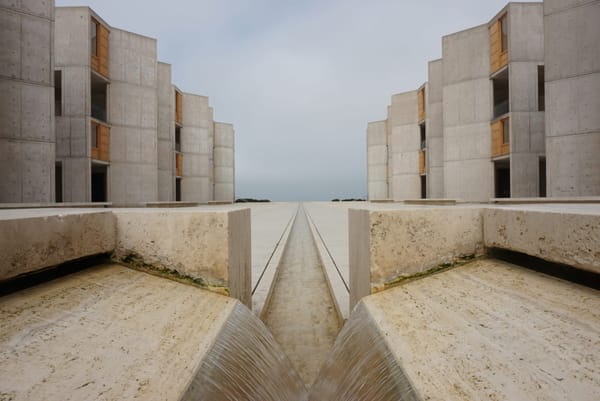
An empty courtyard. That is all. A wide floor of pale stone, with no trees, no benches, no grass. On either side, concrete buildings step back in perfect symmetry, their wooden window frames turned silver by the sea air. Down the middle of the floor runs a thin line of water, barely a hand wide. Follow it with your eyes, and it leads you straight to the edge, and over the edge, the Pacific Ocean. The only sound is the water.
This is Sounding. I'm Maren Holt. Episode twelve: the Salk Institute.
The Salk Institute for Biological Studies stands on a cliff in La Jolla, in San Diego, California. It was founded by Jonas Salk, the scientist who developed the first effective polio vaccine. In the late nineteen fifties, Salk wanted to build a place where scientists could do research in the best possible conditions. He chose the architect Louis Kahn. The buildings opened in nineteen sixty five.
There is a story about what Salk asked for. The way Kahn told it, Salk wanted a laboratory worthy of a visit by Picasso. A place for scientists, but beautiful enough to impress an artist. Whether he said exactly that, nobody can quite prove. But you can see the ambition in every corner.
The plan is simple. Two long laboratory buildings, mirror images of each other, face each other across a courtyard. The labs themselves are big open floors. And between every two lab floors, there is a full height floor just for pipes, ducts and cables. That means the labs can be rebuilt and rewired without anyone drilling through the ceiling of the floor below. Kahn understood that science changes, and that a lab building has to change with it.
Facing the courtyard, there are small towers with private studies for the scientists, thirty six of them. Each has a wooden window that slides open to the breeze, and an angled wall that turns the view towards the ocean. The labs are for experiments. The studies are for thinking.
And then there is the concrete. Kahn worked on it like a craftsman. The mix included pozzolan, a volcanic ash. Nothing was ground smooth, nothing was filled, nothing was painted. Even the small holes left by the formwork were kept as part of the pattern, closed with plugs of lead.
But the most famous decision was about what not to put there.
While the courtyard was still undecided, Kahn invited the Mexican architect Luis Barragán to visit. Barragán looked at the space, and, as Kahn later told the story, said: do not put a single tree or blade of grass here. Make it a plaza. Then you will have a facade to the sky.
So that is what it became. A floor of travertine stone, open to the sky above and the ocean ahead. And in the middle, that thin channel of water. Salk and Kahn called it the River of Life. Salk said it represented the trickle of knowledge produced by the institute. Twice a year, at the spring and autumn equinox, the sun sets exactly in line with it, and the channel turns into a line of light pointing at the sea.
So what does the Salk Institute sound like?
Almost nothing. That is its genius. A large empty space, with hard stone and concrete on every side, could easily become an echo chamber. But here, the one sound that fills it is the water in the channel. One writer described a feeling of calm throughout the building, echoed in the constant small splash of the water. Kahn himself talked about how the water goes down the middle of the court and feels like it empties into the ocean. You hear a trickle. Beyond it, the Pacific. Between them, nothing at all.
That is what this building says, I think. That emptiness can be the most expensive thing an architect gives you. Kahn could have filled the courtyard with gardens and paths and benches. Instead, he left it open, and let the sky, the sea and one small stream of water do the work.
The teak windows did need help eventually. Decades of salt and sun took their toll, and in a four year project that finished in two thousand seventeen, the Getty Conservation Institute and the institute restored more than two hundred window walls. Over two thirds of the original wood was saved and put back.
One detail to take with you. Go at the equinox, near sunset. Stand at the top of the courtyard, and watch the sun slide down into the sea, exactly at the end of the water.
That was Sounding, episode twelve. I'm Maren Holt. Keep listening to the buildings around you.
Credits
Music: "Podcast Intro Logo" by lsMusic on Pixabay.
Sounding is a demo show by Aftertype. Maren Holt is fictional; her voice is synthetic.


Discussion