

Sources
- britannica.com/topic/Hagia-Sophia
- whc.unesco.org/en/list/356
- pbs.org/wgbh/...
- roughguides.com/destinations/...
- smarthistory.org/hagia-sophia-istanbul
- projects.mcah.columbia.edu/medieval-architecture/...
- cambridge.org/core/...
- globalnews.ca/news/...
- ccrma.stanford.edu/groups/...
- arts.stanford.edu/excavating-an-echo
- art.stanford.edu/news/...
- cappellaromana.org/cappella-romana-and-ccrm/...
Transcript
Dawn, inside one of the largest rooms of the ancient world. A woman stands under the dome with small microphones clipped near her ears. A guard holds up a balloon. He has agreed to pop four of them, no more. The first one bursts. And the sound does not stop. It rises into the dome, rolls around the galleries, comes back down, and keeps going, fading slowly, for more than ten seconds.
This is Sounding. I'm Maren Holt. Episode fourteen: Hagia Sophia.
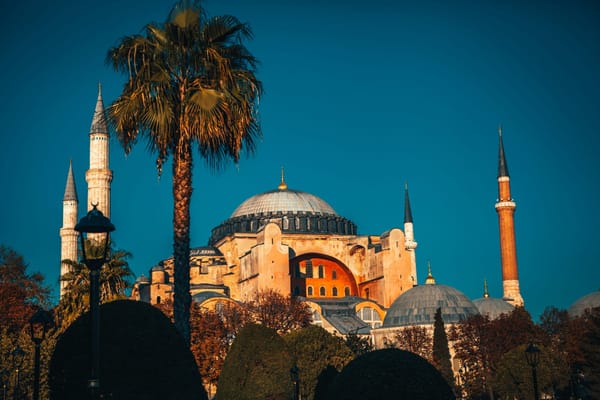
Hagia Sophia stands in Istanbul, on the old peninsula between the Golden Horn and the Sea of Marmara. Its name means Holy Wisdom. It was built for the Byzantine emperor Justinian, between the years five hundred thirty two and five hundred thirty seven. In less than six years. The architects were Anthemius of Tralles and Isidore of Miletus, two men better known in their time as mathematicians than as builders.
What they built was a dome that seems to float. It is more than thirty metres across, and its top is about fifty five metres above the floor. At its base, there is a ring of forty windows, so close together that the light pours in all around the bottom edge of the dome. From below, the dome seems to sit on nothing but light. A writer of the time, Procopius, said it did not seem to rest on solid masonry at all, but to cover the space as if it were hanging down from heaven.
There is a famous story that when Justinian first walked in, he said: Solomon, I have outdone thee. It is a wonderful line. Unfortunately, it was first written down about three hundred years later. Treat it as a legend.
The dome did not float forever. Earthquakes damaged it, and in the year five hundred fifty eight, part of it collapsed. It was rebuilt steeper and higher, and the church was consecrated again a few years later. In fourteen fifty three, when the Ottomans took the city, Sultan Mehmed the Second made it a mosque. Minarets were added, and many of the mosaics were covered. In the nineteen thirties, the young Turkish republic turned it into a museum. And since twenty twenty, it has been a mosque again. Through all of that, the building stayed. It has been a model for churches and mosques around the world for nearly fifteen hundred years.
So what does Hagia Sophia sound like?
That is exactly what the woman with the balloons wanted to know. She is Bissera Pentcheva, an art historian at Stanford University. Together with the acoustics researcher Jonathan Abel, she started a project called Icons of Sound. In twenty ten, they recorded those balloon pops under the dome, and used them to capture the building's acoustic fingerprint.
The result is remarkable. In a modern concert hall, a sound dies away in under two seconds. Under the dome of Hagia Sophia, it lingers for more than ten seconds, around eleven in the middle frequencies. A single note becomes a cloud. Words blur into each other. Abel has said that a short chant of three lines can take more than three minutes to sing in that space, because the singers have to wait for the building.
Using a computer model of that fingerprint, they did something extraordinary. In twenty thirteen, the vocal ensemble Cappella Romana gave a concert in a hall at Stanford. The singers sang Byzantine chant into microphones, and the sound was played back through loudspeakers as if they were standing under the dome in Istanbul. Later, they released it as an album, Lost Voices of Hagia Sophia.
Pentcheva describes the experience beautifully. In that space, she says, your breath is extended and stretched out by surfaces of marble and gold. The sound is not there to carry information. It is there to make you feel something. In a building like this, the walls and the voices and the gold of the mosaics become one thing.
That is what this building says, I think. That some spaces are designed to slow time down. Eleven seconds is a long time for a sound to stay in the air. Long enough to stop thinking, and just listen.
One detail to take with you. When you stand under the dome, say something quietly and then stop. Count. One, two, three. You will still hear yourself, for longer than you expect, somewhere up there in the light.
That was Sounding, episode fourteen. I'm Maren Holt. Keep listening to the buildings around you.
Credits
Music: "Podcast Intro Logo" by lsMusic on Pixabay.
Sounding is a demo show by Aftertype. Maren Holt is fictional; her voice is synthetic.


Discussion