

Sources
- direzionemuseiroma.cultura.gov.it/en/...
- britannica.com/topic/...
- smarthistory.org/the-pantheon
- italia.it/en/lazio/rome/pantheon
- depts.washington.edu/hrome/...
- depts.washington.edu/hrome/...
- visitlazio.com/en
- turismoroma.it/en/places/fountain-pantheon
- maths.tcd.ie/EMIS/...
Transcript
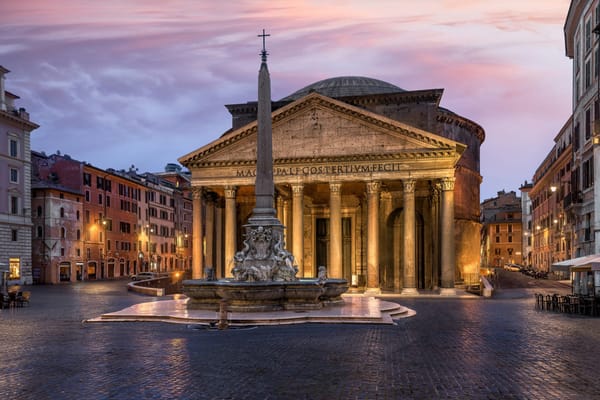
Early morning in Rome. The square is almost empty. A fountain splashes in the middle of it, the cafes are still stacking their chairs, and the stones are wet from the night. Behind the fountain stands a porch of sixteen granite columns, and behind the porch, a wall of brick that has been standing here for nearly two thousand years. Walk through the bronze doors, and the noise of the city stays outside. Look up. There is a hole in the roof. And through that hole, the sky.
This is Sounding. I'm Maren Holt. Episode one: the Pantheon.
The Pantheon stands on the Piazza della Rotonda, in the old heart of Rome. The building you see today was raised under the emperor Hadrian, and finished around the year one hundred and twenty five. It replaced an earlier temple on the same spot, built by Marcus Agrippa, the son-in-law of Augustus, more than a century before.
And here is the first strange thing. Look at the front, above the columns. In large letters it says that Marcus Agrippa, consul for the third time, made this. He did not. Hadrian did. But Hadrian put the old name back on his new building, as if to say: this was always here. The letters you see now are modern bronze, but the gesture is ancient. A building that lies about its age, politely.
Inside, the Pantheon is built around a single idea, and it is a perfect one. The dome is about forty three metres wide, and the distance from the floor to the top is the same. You could fit an enormous ball inside, and it would just touch the floor and the crown of the dome. It is still the widest dome ever built in unreinforced concrete. No steel. Just Roman concrete, poured in layers.
The builders knew it had to get lighter as it went up. So at the bottom of the dome they used heavy stone in the mix, and near the top, light volcanic pumice. They also carved the inside into coffers, five rows of twenty eight square hollows, each one smaller than the one below. That saves weight. It also makes the dome look even deeper than it is.
And then, at the very top, there is nothing. The oculus. A round opening almost nine metres across, open to the sky. It is the main source of light in the whole building. On a sunny day, a sharp disc of sunlight moves slowly across the coffers and down the walls and over the floor, like the hand of a clock that nobody has to wind.
When it rains, it rains inside. The floor is gently shaped to carry the water away, and there are small drainage holes near the centre, twenty two of them, that take it down. Imagine standing there on a wet afternoon. Around you, the dry hush of an enormous room. In the middle, a column of falling rain, landing on marble, perfectly framed.
So what does the Pantheon sound like?
Mostly, it sounds like people trying to be quiet. Voices drop when they come in. Footsteps soften. A big round room with a stone floor holds on to sound, and every whisper seems to travel further than you meant it to. One visiting scholar once sang three notes standing in the centre and said they hung together in the air like a chord. He admitted himself that he never measured it. But it tells you something about the room. You start listening to it.
What does it say? That a building can be both a machine and a gesture. The dome is pure engineering, every layer calculated against its own weight. And the hole at the top undoes all of it. It lets in weather, and time, and whatever the sky is doing. The most solid building in Rome is open at the top.
That openness may be why it survived. In the year six hundred and nine it became a church, and a building in use is a building that people look after. The painter Raphael is buried here. So are two kings of Italy. And every year at Pentecost, firefighters climb onto the roof and drop thousands of red rose petals through the oculus, and they drift down onto the people standing below.
One detail to take with you. Before you go inside, stand at the fountain in the square and turn around. The obelisk on top of it is Egyptian, made for the pharaoh Ramesses the Second, and set here in seventeen eleven. A three thousand year old stone, looking at a two thousand year old dome. In Rome, that counts as neighbours.
That was Sounding, episode one. I'm Maren Holt. Keep listening to the buildings around you.
Credits
Music: "Podcast Intro Logo" by lsMusic on Pixabay.
Sounding is a demo show by Aftertype. Maren Holt is fictional; her voice is synthetic.

Discussion