

Sources
- en.wikipedia.org/wiki/Nakagin_Capsule_Tower
- nakagincapsuletower.com/project
- dezeen.com/2023/...
- moma.org/collection/works/434291
- khaleejtimes.com/world/...
- architecturelab.net/the-nakagin-capsule-towe/...
- tofugu.com/travel/...
- gmanetwork.com/news/...
- stripes.com/theaters/...
- news.artnet.com/art-world/...
Transcript
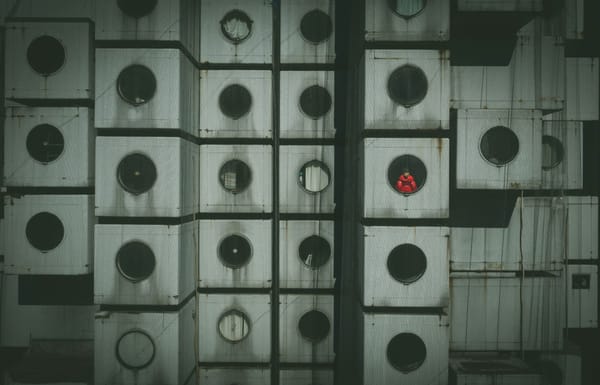
Imagine a box about the size of a small van. You step inside. In front of you, a single round window, more than a metre across, like a porthole on a ship. Below it, a bed. Along one wall, a small fridge and a television. And built into the wall, a reel to reel tape deck, waiting for you to press play. Outside the window, Tokyo is roaring. Inside, it is almost silent.
This is Sounding. I'm Maren Holt. Episode seven: the Nakagin Capsule Tower.
The Nakagin Capsule Tower stood in Ginza, on the Shimbashi side, in the centre of Tokyo. It was designed by the Japanese architect Kisho Kurokawa and completed in nineteen seventy two. And this is the only episode of the series about a building you can no longer visit. In twenty twenty two, it was taken apart.
To understand it, you have to know about an idea called Metabolism. In the nineteen sixties, a group of young Japanese architects argued that cities should behave like living things. They should grow, change, shed old parts and grow new ones. Buildings should not be fixed monuments. They should be systems, with a permanent core and replaceable pieces.
The Nakagin tower was that idea, built. Two concrete towers, one of eleven storeys and one of thirteen, held the lifts, stairs and pipes. Onto those cores, the builders attached one hundred and forty capsules. Each one was made in a factory, far from Tokyo, finished with its furniture and equipment inside, then brought to the site and fixed to the core with just four high strength bolts. Each capsule was a little room of its own, roughly two and a half metres wide and four metres long.
The plan was that the capsules would be replaced every twenty five years. Unbolt the old one, lift it off with a crane, bolt a new one in its place. A building that could renew itself.
It never happened. Not once. Not a single capsule was ever replaced.
The capsules were meant for businessmen who worked in the city and needed somewhere small to sleep during the week. Later, many owners used them as offices and studios. Designers, filmmakers, and musicians moved in. Over the years, the building aged the way any building does if nobody renews it. Pipes corroded. Water leaked in through cracks in the steel. In twenty ten, the hot water was shut off for good. The tower became famous, and at the same time, more and more difficult to live in.
So what did the Nakagin Capsule Tower sound like?
Outside, Shimbashi throbs with noise late into the night. Traffic, trains, bars. But inside a capsule, people describe something else. Quiet. Each capsule was bolted to the core, but not to its neighbours, so sound did not travel easily from one room to the next. The round window had two layers of glass, with air between them, which helped too. One long time owner said simply that he loved it because it got so quiet in there. Some residents reportedly used their capsules as music rooms.
And then there was the tape deck. In the nineteen seventies, the capsule came with the latest equipment built in. A television. A reel to reel tape recorder, a Sony in at least one surviving capsule. The building was designed for a person alone with their music, in a tiny pod, high above one of the biggest cities on earth.
That is what this building says, I think. That a building can be a promise, and that promises need maintenance. Kurokawa designed a structure that was supposed to change. What it needed was people willing to keep changing it.
When demolition began in April twenty twenty two, that was not quite the end. Twenty three of the capsules were saved and restored, under the supervision of Kurokawa's own office. They have been travelling ever since, to galleries and museums. The San Francisco Museum of Modern Art acquired the architect's own capsule. The Museum of Modern Art in New York acquired another, and made it the centrepiece of an exhibition. In the end, the capsules did what the building was designed for. They came off the core, one by one, and started new lives somewhere else.
One detail to take with you. If you ever stand in front of one of those capsules in a museum, look at the window. That round frame is what Tokyo looked like, from inside, to everyone who lived there.
That was Sounding, episode seven. I'm Maren Holt. Keep listening to the buildings around you.
Credits
Music: "Podcast Intro Logo" by lsMusic on Pixabay.
Sounding is a demo show by Aftertype. Maren Holt is fictional; her voice is synthetic.


Discussion