

Sources
- whc.unesco.org/en/list/491
- argolisculture.gr/en/...
- ancienttheatrearchive.com/theatre/...
- sciencedaily.com/releases/...
- hg.gatech.edu/node/72238
- nature.com/news/...
- smithsonianmag.com/smart-news/...
- cursor.tue.nl/en/...
- aefestival.gr/history
Transcript
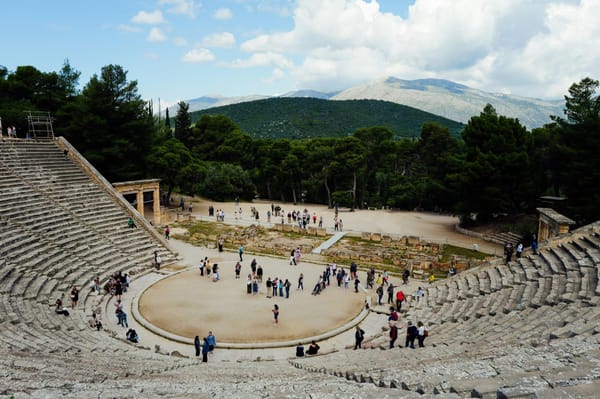
A tour guide walks into the middle of a round stone floor. Around her, rows of limestone seats rise up the hillside in a great curve, and the people on them have gone quiet. She holds up a coin. She drops it. And somewhere high above, near the pine trees at the top, a few visitors raise their hands, delighted. They heard it. Or they think they did.
This is Sounding. I'm Maren Holt. Episode eight: the theatre of Epidaurus.
Epidaurus is in the Peloponnese, in southern Greece. In ancient times it was one of the great healing places of the Greek world, a sanctuary dedicated to Asklepios, the god of medicine. People came from far away, hoping to be cured. And they went to the theatre.
The theatre was built in the late fourth century before the common era. The ancient travel writer Pausanias, who saw it several centuries later, credited it to an architect called Polykleitos, and asked who could possibly rival him for symmetry and beauty. It is still one of the best preserved theatres of the ancient world. Around fifty five rows of seats, enough for something like thirteen or fourteen thousand people, curving around a perfectly round orchestra about twenty metres across. The view from the top goes over the seats, over the stage, and out across a valley of pine forest.
Since nineteen eighty eight, the sanctuary has been a World Heritage Site, and UNESCO describes the theatre with two words that have followed it for centuries: perfect proportions, and exemplary acoustics.
And that is where the coin comes in.
For as long as people have visited Epidaurus, guides have told them the same story. Stand in the centre of the orchestra and whisper, and you will be heard in the very last row. Drop a coin, strike a match, tear a piece of paper, and fourteen thousand people will hear it. It is one of the most famous claims about any building in the world.
So what does Epidaurus actually sound like?
In two thousand seven, two researchers at Georgia Tech in the United States published a study that seemed to explain the magic. The rows of stone seats, they found, act like a filter. They hold back low frequency sound, the background murmur of an audience and the rustle of the trees, and let the higher frequencies of the human voice ring out. The low parts of a voice get lost too, but the brain fills them back in on its own. It is a trick of hearing called virtual pitch. A theatre that quietly cleans up the noise, and lets the voice through.
Ten years later, a team from Eindhoven University of Technology in the Netherlands went to measure it properly. They took more than ten thousand measurements in three ancient Greek theatres, including Epidaurus. Their findings were a little less romantic. A dropped coin and tearing paper could be heard all the way up, but beyond about halfway, you could no longer tell what the sound was. A whisper only really carried to the front rows. Normal speech did not reach the back. A trained, projected voice did.
In other words: very good acoustics. Not miraculous ones. And the researchers added one careful note. They had measured the theatre as it is today, with worn stone, missing parts, and an audience of tourists instead of a costumed chorus. How it sounded two and a half thousand years ago, nobody can measure.
Notice the pattern here. In episode one, at the Pantheon, a scholar sang three notes and heard a chord, and never measured it. At Epidaurus, people have heard coins drop for centuries, and when someone finally measured it, the legend shrank a little. Buildings make us want to believe in them.
But the theatre does not need the legend. Since the nineteen fifties, it has been a working stage again. The Epidaurus festival, now part of the Athens and Epidaurus Festival, brings ancient Greek plays back to the place they were written for. Audiences climb the same rows and listen to actors who have learned to use the space the way it was meant to be used: with trained voices, aimed at the top.
That is what this building says, I think. That good acoustics are not a miracle. They are a collaboration. The stone does its part. The actor does the rest.
One detail to take with you. If you visit, skip the coin. Stand in the centre and say something in a normal voice, then walk up to the top and ask a friend to do the same. You will hear exactly how much the theatre is doing for you, and how much it is leaving to you.
That was Sounding, episode eight. I'm Maren Holt. Keep listening to the buildings around you.
Credits
Music: "Podcast Intro Logo" by lsMusic on Pixabay.
Sounding is a demo show by Aftertype. Maren Holt is fictional; her voice is synthetic.



Discussion