

Sources
- elbphilharmonie.de/en/elbphilharmonie
- elbphilharmonie.de/en/elbphilharmonie-building
- elbphilharmonie.de/en/...
- elbphilharmonie.de/en/...
- herzogdemeuron.com/projects/...
- permasteelisagroup.com/wp-content/...
- srf.ch/kultur/...
- thelocal.de/20161101/...
- leinetal24.de/welt/...
- constructionmanagement.co.uk/algorithms-design-hambur/...
- heidelberg24.de/deutschland/...
Transcript
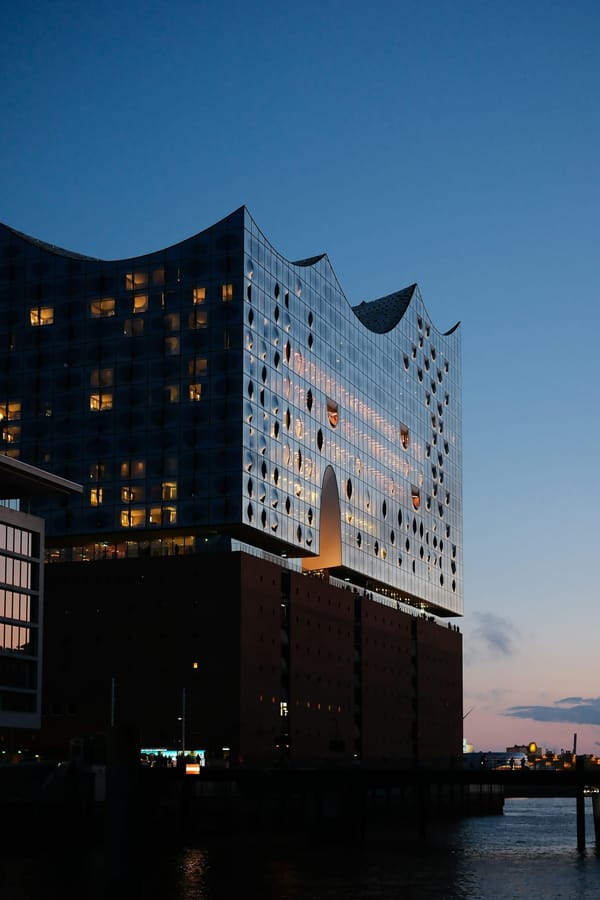
Dusk in the port of Hamburg. A ship's horn, somewhere down the river. Cranes against a darkening sky. And at the tip of a narrow strip of land between the docks, a dark brick block, heavy and square, like something left over from another century. On top of it, a crystal. A wall of glass that rises and dips along the top, like a wave that has just decided to break. One by one, the windows start to glow.
This is Sounding. I'm Maren Holt. Episode ten: the Elbphilharmonie.
The Elbphilharmonie is a concert hall on the river Elbe in Hamburg. It was designed by the Swiss architects Herzog and de Meuron, and it opened in January twenty seventeen. It is about one hundred and ten metres tall at its highest point. And it is really two buildings, stacked.
The bottom one is Kaispeicher A, a warehouse finished in nineteen sixty six. For decades it stored goods coming in by ship: cocoa, tea, tobacco. Heavy sacks, thick walls, almost no windows. The architects kept it. They put the new building on top, held up by the warehouse and by more than a thousand piles driven into the riverbed.
The top one is the glass. More than a thousand prefabricated facade elements, some two thousand two hundred panes, and around six hundred of them curved, bulging outward like lenses. The glass is printed with tiny reflective dots and grey patterns. On the west and south sides, the pattern was even adjusted so the facade would not confuse the port's radar.
It took a long time to get there. The plan in two thousand five was to open in twenty ten. The public share of the cost was set at seventy seven million euros. By twenty fourteen, an inquiry put the public share at seven hundred and eighty nine million, and the total ended up near eight hundred and sixty six million. For years, the Elbphilharmonie was the example everyone in Germany reached for when a public building went wrong. Then it opened, and people stopped laughing and started queueing.
You enter by escalator. It is called the Tube, it is eighty two metres long, and it curves so you cannot see the end of it from the start. It takes about two and a half minutes. At the top, you step out onto the Plaza, thirty seven metres up, a public terrace between the old warehouse and the new glass, with the whole harbour around you.
But the reason the building exists is above that. The Grand Hall.
So what does the Elbphilharmonie sound like?
The hall was shaped with the Japanese acoustician Yasuhisa Toyota. It seats about two thousand one hundred people, and they do not sit in rows facing a stage. They sit around it, on terraces that climb up on every side, like vineyards on a hill. Some three hundred seats are even behind the orchestra. No seat is more than thirty metres from the conductor.
Then there is the skin. The walls and ceiling are covered in more than ten thousand gypsum fibre panels, each one milled individually by machine. Look closely and every panel is covered in small cells, about a million of them in total, carved deeper in some places and shallower in others. The flat parts reflect sound. The deep hollows scatter it. Nobody drew those cells by hand. An algorithm placed each one, according to where the sound needed to go.
And the whole hall floats. It rests on three hundred and sixty two groups of springs, and its inner shell never touches the outer concrete walls. The port, the ships, the horns, the city: none of it gets in. Inside, it is quiet enough to hear someone turn a page.
That precision has a price. The hall is honest. It does not blur. Every cough, every rustle, every note reaches you clearly, wherever you sit. In twenty nineteen, during a concert with a star tenor, part of the audience behind the stage could not hear the singer over the orchestra, and some walked out. The hall's director later admitted that the room, not the artists, was to blame. A hall built for clarity is merciless about where you put a voice.
That is what this building says. You can put something new on top of something old without erasing it. A warehouse for cocoa sacks now carries a room built to the millimetre for sound. Heavy below. Weightless above.
One detail to take with you. When you are in the Grand Hall, put your hand on the wall. Those little hollows under your fingers are why the music sounds the way it does.
That was Sounding, episode ten. I'm Maren Holt. Keep listening to the buildings around you.
Credits
Music: "Podcast Intro Logo" by lsMusic on Pixabay.
Sounding is a demo show by Aftertype. Maren Holt is fictional; her voice is synthetic.



Discussion