

Sources
- whc.unesco.org/en/list/445
- en.wikipedia.org/wiki/Brasília
- en.wikipedia.org/wiki/...
- camara.leg.br/noticias/...
- www2.camara.leg.br/a-camara/...
- www2.camara.leg.br/espanol/visite-la-camara
- artsandculture.google.com/story/...
- arquitecturaviva.com/works/...
- revistapesquisa.fapesp.br/en/calculus-of-a-poet
Transcript
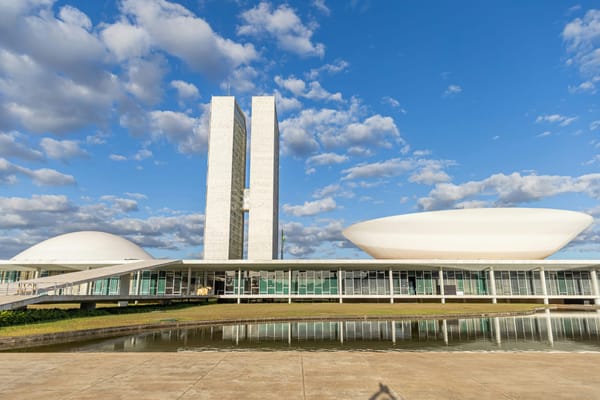
A Sunday morning in Brasília. The wide avenue in front of you, built for heavy traffic, is closed to cars. People are cycling down the middle of it. Children are running. Without the engines, you can hear the wind across the open grass. And at the end of the avenue, low and white against a huge sky, there is a building that looks like a sentence written in three shapes: two tall slabs, a bowl, and a dome.
This is Sounding. I'm Maren Holt. Episode two: the National Congress of Brazil.
Brasília is a city that did not exist until it was built, all at once. In the second half of the nineteen fifties, President Juscelino Kubitschek promised fifty years of progress in five, and one part of that promise was a new capital, moved from the coast to the empty high plains in the middle of the country. It took about forty one months. On the twenty first of April, nineteen sixty, the city was inaugurated, and on that same day the legislature moved in.
The plan of the city was drawn by Lúcio Costa. People like to say it is shaped like an aeroplane, or a bird. Costa himself described it more simply, as a cross adapted to the land. The buildings were designed by Oscar Niemeyer. And at the end of the great central axis, next to the Square of the Three Powers, he placed the Congress.
Here is how to read it. Two towers, twenty eight storeys each, standing side by side with a narrow gap between them. That is where the offices are. In front of them, a long flat platform, and on top of that platform, two shapes. On one side, a bowl, open to the sky. Underneath it is the Chamber of Deputies. On the other side, a dome, closed like a lid. Underneath it, the Senate. The Chamber's bowl is bigger, because it has more members.
People have read a lot into those shapes. An open bowl for the voice of the people, a closed dome for calm reflection. It is a lovely idea. But the Chamber's own account quotes Niemeyer saying the arrangement was, in the end, a matter of aesthetics. And it was also practical: the rooms needed public galleries, a place for citizens to sit and watch.
The bowl was the hard part. Turning a dome upside down and asking it to stand on a slab is not a small request. The engineer who made it work was Joaquim Cardozo, who was also a poet. Somewhere in that structure, there is a poem nobody can read, written in reinforced concrete.
The roof of the platform sits at the level of the road. So if you drive towards it, the building does not block your view. You look between the bowl and the dome and straight through to the Square of the Three Powers beyond. Around it, long water mirrors reflect the towers, and lawns stretch out on every side.
So what does the Congress sound like?
The honest answer is that a parliament is a building for voices. The bowl and the dome are rooms where hundreds of people speak, argue, and vote, and where hundreds more sit in the galleries to listen. The Chamber's public gallery alone has around four hundred seats. Everything about the building is designed so that those two rooms, and the people in them, are the first thing you see.
But outside, it is a city built around the car. The distances are long, the avenues are wide, and on a normal weekday the sound of Brasília is traffic moving fast across open space. Critics have said for decades that the plan was made more for drivers than for people on foot. Which is why those Sundays matter. When the axis closes to cars, the city goes quiet, and you suddenly hear how big it is.
That is what this building says, I think. That a country can draw its own future on a blank sheet of paper, and then has to live in the drawing. The forms are pure and confident, a bowl, a dome, two slabs, the shapes a child might pick to explain government. The life around them is messier, louder and more human.
Since nineteen eighty seven, the whole of Brasília has been a World Heritage Site.
One detail to take with you. Look up when you are inside the Senate. The ceiling of the dome is lined with metal plates designed by the artist Athos Bulcão. Under the closed lid of the dome, the light moves over them like slow water.
That was Sounding, episode two. I'm Maren Holt. Keep listening to the buildings around you.
Credits
Music: "Podcast Intro Logo" by lsMusic on Pixabay.
Sounding is a demo show by Aftertype. Maren Holt is fictional; her voice is synthetic.

Discussion