

Sources
- alhambra-patronato.es/en/...
- alhambra-patronato.es/en/...
- alhambra-patronato.es/en/...
- alhambra-patronato.es/en/...
- alhambra-patronato.es/en/...
- en.wikipedia.org/wiki/Alhambra
- en.wikipedia.org/wiki/Court_of_the_Lions
- en.wikipedia.org/wiki/Tales_of_the_Alhambra
- britannica.com/topic/...
- whc.unesco.org/en/list/314
- journals.hipatiapress.com/index.php/...
- eldebate.com/espana/...
- elobservador.com.uy/nota/...
Transcript
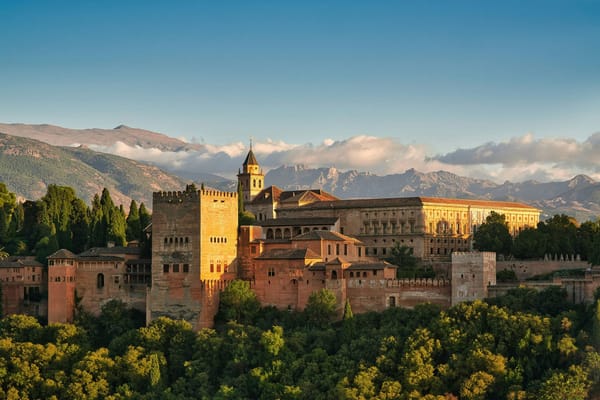
Late afternoon in Granada. The sun is low, and it hits a long ridge above the city. On that ridge, walls and towers turn from sand to orange to deep red. Behind them, far away, the snow on the Sierra Nevada catches the same light. And if you could walk up there now, through the gates and into the palaces, the first thing you would notice is not the colour. It is a sound. Somewhere, always, water is moving.
This is Sounding. I'm Maren Holt. Episode six: the Alhambra.
The Alhambra sits on the Sabika hill, above the city of Granada in southern Spain. Its name comes from Arabic, and it means the red one. The red fortress. The walls are made of rammed earth, and the iron in the local clay gives them that colour, especially at sunset.
It was built by the Nasrids, the last Muslim dynasty to rule in Spain. Construction began in twelve thirty eight. The oldest part is the fortress at the western end, the Alcazaba. But the palaces that people travel across the world to see came later, in the fourteenth century, under two rulers in particular: Yusuf the First and Muhammad the Fifth. They built the Comares Palace, with its great Hall of the Ambassadors, and the Palace of the Lions.
In January fourteen ninety two, Granada surrendered to the Catholic Monarchs, Ferdinand and Isabella. The last sultan, Boabdil, handed over the keys. And then something unusual happened. The new rulers did not tear the Alhambra down. They moved in. A few decades later, the emperor Charles the Fifth even started building his own Renaissance palace right in the middle of it, a perfect square with a round courtyard inside. You can see it in the photo for this episode, the large pale block behind the red towers. It was never finished.
So how does a palace on a dry hill fill itself with water?
The answer is a channel. The Royal Canal takes water from the river Darro, about eleven kilometres upstream, and carries it around the hillside, watering the orchards of the Generalife gardens on the way, and then into the palace city itself. From there it is divided, slowed down, lifted, lowered, and let go again. Into pools. Into thin channels cut into marble floors. Into fountains in the middle of rooms.
Take the Hall of the Two Sisters. It is named after two large marble slabs in the floor. Between them is a small fountain, and from that fountain a narrow channel runs out of the room, across the threshold, and into the Court of the Lions. You can follow the water with your eyes, from one space to the next. The building is literally connected by a thread of moving water.
Above your head in that same hall, the ceiling explodes into thousands of tiny carved cells, like a honeycomb, or frozen dripping water. They are called muqarnas. They catch the light from the small windows high up and scatter it, so the dome seems to float.
And then the Court of the Lions itself. A courtyard of slender columns, and in the centre a fountain carried by twelve marble lions. Around the rim of the basin, a poem is carved in Arabic, written by the court poet Ibn Zamrak. It describes the water flowing while the basin holds it still, like a lover holding back tears. The original fountain was designed so that the surface stayed calm and level. Moving water that looks like it is resting. Between two thousand two and twenty eleven, the lions were taken away, restored, and brought back.
So what does the Alhambra sound like?
In twenty sixteen, the researcher Josep Cerdà walked through the complex with binaural microphones and mapped the sound of water, place by place. His conclusion: the sound of water is not decoration here. It is one of the things that shapes each room. Every courtyard, every garden, has its own voice. A trickle here, a ripple there, a near silence in a hall where the water barely moves.
That is what the Alhambra says. That luxury, in a dry land, is not gold. It is water you can hear. And that silence is something you can design, by giving people one small sound to listen to.
Today, around two point seven million people visit the Alhambra every year. There is a cap, for the sake of the building, and the Nasrid Palaces let in only a few hundred people every half hour. It helps that the American writer Washington Irving lived here for a few months around eighteen twenty nine, and published his Tales of the Alhambra in eighteen thirty two. Europe fell in love with it all over again.
One detail to take with you. When you walk through the palaces, look down, not up. Follow the narrow water channels in the floor. They will show you the way the building wants you to move.
That was Sounding, episode six. I'm Maren Holt. Keep listening to the buildings around you.
Credits
Music: "Podcast Intro Logo" by lsMusic on Pixabay.
Sounding is a demo show by Aftertype. Maren Holt is fictional; her voice is synthetic.

Discussion